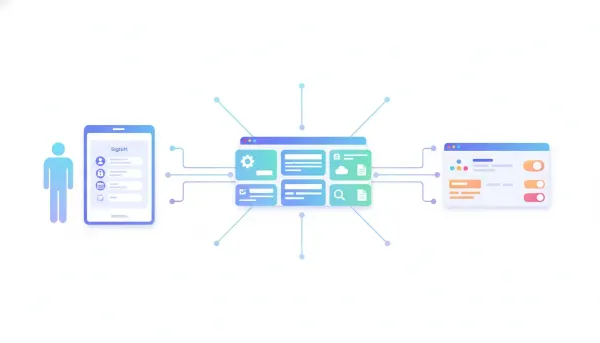
Meet Visual Edits in AI Studio


Visual Edits in AI Studio are live, and the core idea is refreshingly simple: select anything on the page and edit it using familiar builder controls.
That one change has a big impact.
Instead of bouncing between generated output and traditional page-building tools, Visual Edits brings a more direct workflow into AI Studio. You click what you want to change, adjust it visually, and keep moving. It feels less like wrestling with generated layouts and more like shaping them.
The Complete Operating System for Growth
Join over 60,000+ agencies and businesses using HighLevel to capture more leads and close more deals. Start your trial today and get instant access to the Nexus Hub resources.
Claim Your Free Trial & BonusesWhat Visual Edits in AI Studio actually means
AI tools are great at helping teams move faster, but speed only matters if the result is easy to refine. In most real-world marketing and CRM workflows, the first version is rarely the final version.
You generate a page, section, or design concept. Then you want to tweak spacing, update text hierarchy, change alignment, adjust colors, or refine a block without rebuilding the whole thing. That is where Visual Edits matters.
Inside HighLevel AI Studio, this feature makes it possible to interact with page elements directly and edit them using the kinds of controls people already expect from a builder experience.
In plain terms, it means:
- You can select a specific part of the page.
- You can edit that part visually.
- You can use traditional builder-style controls instead of relying only on prompts or regeneration.
That combination makes AI Studio more practical for everyday production work.
Why this matters for HighLevel users
For agencies, marketers, and SaaS operators working inside GoHighLevel, efficiency is never just about creating something quickly. It is about creating something quickly and making it usable without friction.
When a page or asset needs revisions, every extra step adds drag to the process. Teams slow down. Handoffs get messy. Simple updates become bigger tasks than they should be.
Visual Edits helps reduce that friction by closing the gap between AI-generated output and polished, production-ready assets.
That is especially useful in environments where speed and iteration are part of the business model, such as:
- HighLevel agency setup and scaling, where teams need repeatable production systems
- CRM and marketing automation delivery, where landing pages and funnels support campaigns
- SaaS operations, where account-level customization needs to happen fast
- Client fulfillment, where small visual changes are constant
If your work includes building pages tied to workflows, lead capture, offers, or client campaigns, direct visual control is not a nice-to-have. It is part of making the whole system efficient.
From AI generation to real editing
A lot of AI-powered creation tools are strong at the first draft and weak at the second step.
They can give you momentum, but not always control.
Visual Edits shifts AI Studio closer to a workflow that teams actually want to use repeatedly. Instead of treating AI output as something fixed unless you regenerate it, you can treat it as a starting point that is easy to shape.
That is a meaningful distinction.
Traditional builder controls are familiar for a reason. They make editing intuitive. They let users move from broad generation to specific refinement without changing mental gears. You can make practical adjustments where they matter most: on the page, on the element, in the moment.
For many teams, that is where adoption happens. Not because a tool can generate something impressive once, but because it is simple to improve over and over again.
The advantage of selecting anything on the page
The phrase “select anything on the page” is the heart of the feature.
It suggests a much more direct and flexible editing model. Rather than navigating through a complicated stack of settings first, the interaction starts with the thing you actually want to change.
That has several practical benefits:
- Faster revisions because you can target specific elements immediately
- Less guesswork because the edit begins from the visual object itself
- Better consistency because builder controls make structured changes easier
- Lower training overhead because the interaction pattern is already familiar to teams using page builders
When teams are building high volumes of client assets, campaign pages, or branded layouts in HighLevel, those small efficiencies add up quickly.
Why builder-style controls still matter in an AI workflow
There is a useful lesson here for anyone working in AI-assisted design and marketing production: AI does not replace the need for controls. It increases the need for good controls.
Generation is powerful, but refinement is where quality lives.
Builder-style controls remain valuable because they are concrete. They help users make intentional changes. They reduce ambiguity. They create a bridge between creativity and execution.
In a HighLevel context, that is important because the final output usually supports a broader operational system. A page is not just a page. It may connect to:
- Lead forms
- CRM pipelines
- HighLevel workflows and automations
- Appointment booking
- Nurture sequences
- Client reporting and campaign performance
When the page is part of a larger business process, editing precision matters. Builder controls give that precision.
What this unlocks for agencies
Agencies using HighLevel are always balancing speed, quality, and repeatability. Visual Edits supports all three.
1. Faster client revisions
Clients almost never ask for a complete rebuild. They ask for tweaks. Change this headline. Tighten that section. Adjust spacing. Update a style choice. Replace one block. Visual editing is ideal for this kind of work.
2. Easier delegation
When tools are intuitive, more tasks can be delegated across the team. Account managers, implementers, and fulfillment specialists can make updates without getting stuck in a heavily technical process.
3. Better production systems
Agency scaling depends on systems, not heroic effort. A workflow that combines AI generation with direct visual refinement is easier to standardize than one that requires constant back-and-forth or manual reconstruction.
4. More useful AI in daily operations
AI becomes most valuable when it is not isolated. Features like Visual Edits make AI Studio more usable as part of real fulfillment, not just experimentation.
How this fits into HighLevel implementation strategy
One of the best ways to think about Visual Edits is not as a standalone novelty, but as part of a broader HighLevel implementation strategy.
If you are building serious systems inside GoHighLevel, your process usually has several layers:
- Offer and messaging setup
- Page or funnel creation
- Form and CRM integration
- Workflow automation
- Follow-up and nurture systems
- Measurement and optimization
AI Studio helps with creation. Visual Edits helps with refinement. And together, those capabilities support the earlier stages of campaign execution much more efficiently.
That means agencies and operators can spend less time wrestling with presentation details and more time improving conversion paths, automations, and client outcomes.
The Complete Operating System for Growth
Join over 60,000+ agencies and businesses using HighLevel to capture more leads and close more deals. Start your trial today and get instant access to the Nexus Hub resources.
Claim Your Free Trial & BonusesA better user experience means better adoption
Tool adoption often comes down to one question: is it easier to use this than to work around it?
Features that feel natural tend to get used. Features that force awkward workflows tend to get ignored, even if they are technically powerful.
Visual Edits solves a practical usability issue. It gives users a direct editing path that matches how people already think when they work on pages: identify the element, click it, change it.
That matters because in marketing automation and CRM environments, the best tool is the one your team can use consistently under deadline pressure.
Where Visual Edits can have the biggest impact
Even with a short product announcement, the use cases are easy to recognize. This kind of feature is likely to be especially valuable anywhere page production and iteration happen at scale.
Landing pages and funnels
When you are building lead generation assets, every section matters. Fast control over page elements helps tighten the final result without slowing momentum.
Client-specific customization
Agencies often work from repeatable templates and then personalize the final asset for each account. Visual editing makes that personalization smoother.
Internal marketing teams
Teams managing ongoing promotions, launches, or campaign refreshes need quick turnaround. Direct edits reduce delays.
SaaS-enabled service delivery
Businesses using HighLevel to package services at scale benefit from workflows that are both fast and easy to train. Builder-style editing supports that operational model well.
Why this is a meaningful product update
Not every feature release needs to be massive to matter. Sometimes the most useful updates are the ones that remove friction from work people do every day.
That is what makes Visual Edits notable.
It does not just add more AI. It makes AI output more editable, more practical, and more aligned with how modern teams actually build. It respects the reality that generated content is usually a first pass, not the finished product.
For users already building inside HighLevel, that is a strong direction. It reinforces the platform’s role not just as a CRM or automation engine, but as a more complete environment for campaign execution.
Best practices for using Visual Edits inside HighLevel workflows
While the announcement is concise, there are a few smart ways to think about implementation if you want to get the most from features like this inside your broader HighLevel setup.
- Start with speed, then refine visually. Use AI Studio to create the initial structure, then use Visual Edits for polish.
- Standardize repeatable layouts. Build from consistent frameworks so edits are focused on client-specific messaging and design adjustments.
- Connect page edits to workflow goals. Every visual change should support a business objective such as conversion, clarity, or lead quality.
- Keep fulfillment simple. The more intuitive the editing process, the easier it is to delegate across your team.
- Use it as part of a system. A page is strongest when tied to CRM organization, automation, and follow-up strategy.
That is where HighLevel tends to shine. It is not just about making pages. It is about connecting pages to the full customer journey.
What this says about the direction of AI Studio
Visual Edits points toward a more mature AI-assisted building experience.
The first wave of AI tools emphasized generation. The next wave is about control, iteration, and production readiness. A feature like this signals that AI Studio is moving beyond novelty and toward operational usefulness.
That is exactly the kind of evolution agencies and businesses need.
When AI is paired with direct editing, it becomes easier to trust in live workflows. Teams can create faster without giving up the ability to refine details. That balance is essential for anyone delivering real client work or running serious marketing systems.
Final thoughts
Visual Edits in AI Studio delivers a simple promise with a lot of practical value: select anything on the page and edit it using traditional builder controls.
That makes AI-generated work more usable. It speeds up refinement. It supports better agency systems. And it fits naturally into the way HighLevel users build landing pages, funnels, CRM-connected assets, and marketing automation experiences.
If you are already building in GoHighLevel, this is the kind of feature that can improve day-to-day execution immediately.
If you are exploring the platform, it is another strong example of how HighLevel keeps bringing creation, editing, CRM, and automation closer together in one place. Starting a HighLevel free trial can be a practical next step if you want to test how AI Studio fits into your own workflow.
And if you want templates, implementation support, and practical guidance for getting more out of your setup, joining the Nexus Hub community can help you turn features like this into repeatable systems.
FAQ
What is Visual Edits in AI Studio?
Visual Edits is a feature in HighLevel AI Studio that lets you select elements directly on a page and edit them using traditional builder-style controls.
How is Visual Edits different from standard AI generation?
Standard AI generation helps create a first draft. Visual Edits adds a direct refinement layer, making it easier to adjust specific parts of the page without relying only on prompts or regeneration.
Who benefits most from this feature?
Agencies, marketers, SaaS operators, and teams using HighLevel for page building, CRM-connected campaigns, and fulfillment workflows are likely to benefit most because they often need fast, precise revisions.
Does this fit into HighLevel agency workflows?
Yes. It supports common agency needs such as faster edits, easier delegation, more consistent fulfillment, and better alignment between page design and broader HighLevel workflows and automations.
Why are builder controls important in AI Studio?
Builder controls provide clear, structured ways to refine generated content. That matters because most AI-created assets need polishing before they are ready for live campaigns or client delivery.
Can Visual Edits help with scaling fulfillment?
Yes. More intuitive editing reduces friction in production, which can make it easier to standardize processes and scale delivery across multiple accounts or campaigns.
The Complete Operating System for Growth
Join over 60,000+ agencies and businesses using HighLevel to capture more leads and close more deals. Start your trial today and get instant access to the Nexus Hub resources.
Claim Your Free Trial & Bonuses