How Noobs vs Pros vs Legends Are Using AI for Content

AI content creation is splitting into three very different levels.
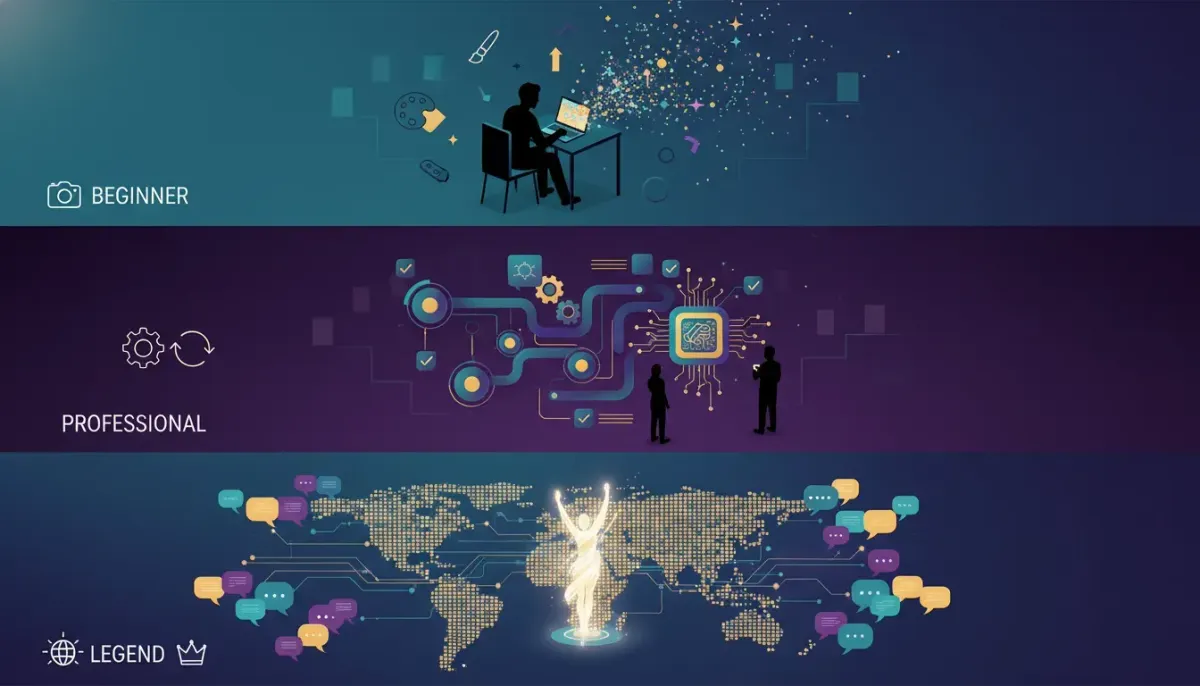
At the beginner level, people use AI to make impressive visuals and test ideas. At the professional level, they use AI to remove themselves as the bottleneck and build a repeatable personal brand system. At the highest level, they use AI to expand the same content into new markets and languages.
If you run a business, agency, or content operation, this matters because each level changes what AI is actually doing for you. It can help you create. It can help you scale. Or it can help you expand distribution far beyond your current audience.
The real difference is not the tool. It is how you use it.
Noobs: Using AI to Make Content That Looks Great
The first stage is where most people start. They open an AI tool and use it to generate cinematic visuals, creative scenes, and eye-catching content.
There is nothing wrong with this stage. In fact, it is useful. You learn what the tools can do, you test style and storytelling, and you get a feel for what grabs attention.
One of the clearest examples here is AI-powered visual storytelling. A creator can combine strong writing, scene generation, and editing to produce short videos that feel polished and dramatic. When the story is strong, those videos can reach very large audiences.
That is an important point. AI visuals alone are not the reason content performs. The real driver is still the story.
What beginners get right:
- They experiment fast.
- They learn what kinds of AI outputs feel engaging.
- They use AI to lower the barrier to creating content.
- They discover styles they may not have been able to produce on their own before.
Where this stage falls short:
- It often stays focused on novelty instead of systems.
- The creator is still doing most of the work manually.
- There is usually no brand engine behind the content.
- Growth can be inconsistent if the content depends on one-off ideas.
If you are here, the goal is not to stop experimenting. The goal is to move from “AI made something cool” to “AI helps me produce good content consistently.”
Pros: Using AI to Scale a Personal Brand
The second stage is where people start thinking like operators.
Instead of only using AI to create a visual or a clip, they use it to build a content system around themselves. That usually means creating an AI avatar, cloning their voice with tools like ElevenLabs, and producing content in a way that does not require them to be present for every single output.
This is where AI stops being a creative toy and starts becoming part of a business workflow.
The key shift: you are no longer the bottleneck
For founders, marketers, consultants, and agencies, this is a major unlock. If your face, voice, and ideas are central to your brand, content creation usually depends on your time and energy. That creates a hard cap. You can only record so much, edit so much, and publish so much.
With AI avatars and voice cloning, you can separate the content system from your physical presence.
That does not mean quality no longer matters. It means the delivery process becomes easier to repeat.
At this level, AI helps you:
- Create more content from the same ideas.
- Keep a consistent voice and brand style.
- Reduce recording time.
- Build a publishing rhythm that is easier to maintain.
- Test content formats on new or smaller accounts.
There is also an important reality check here. This works when the content itself is actually good. AI can help with volume and consistency, but it cannot rescue weak ideas.
That is true whether you are building a creator brand, a service business, or a media arm for your company. If your content lacks clarity, relevance, or substance, publishing more of it will not solve the problem.
What this looks like in a business setting
If you run a company, this stage can become part of your content operation very quickly.
- Your founder can turn one set of ideas into multiple short videos.
- Your agency can produce thought pieces for clients without needing constant recording sessions.
- Your internal marketing team can build repeatable workflows around scripts, voice generation, and avatar delivery.
- Your sales or education team can repurpose core messages into different formats for different channels.
This is also where workflow design matters. You need clean inputs, approved messaging, and a review process. If you already use a CRM or automation platform such as HighLevel for campaign management and follow-up, this kind of AI content production can fit into a larger operating system. But the main point is not the software stack. The main point is removing unnecessary dependency on one person doing everything manually.
Legends: Using AI to Multiply Reach Across Languages
The third stage is where AI starts changing distribution, not just production.
This is the level used by large creators and major brands. Instead of creating brand new content from scratch for every audience, they take the same core content and use AI to translate and dub it into multiple languages.
That is a very different move.
You are no longer asking, “How do I make more content?”
You are asking, “How do I get the same proven content in front of more people?”
Why multilingual dubbing matters
If a piece of content already works in one language, there is a strong chance it can work in another, especially if the topic is broad and the message is clear. AI dubbing gives you a way to test that without building an entirely separate production process for each market.
That is why this approach is so powerful for creators and brands trying to expand globally.
Instead of recording separate versions one by one, you can upload a video, choose the target language, and generate dubbed versions that preserve your original voice characteristics and emotional delivery.
That last part matters more than most people realize. Robotic translation kills trust. If the voice still sounds like you and keeps the original tone, the content feels far more natural.
ElevenLabs recently introduced a newer dubbing model aimed at this kind of workflow. The process is simple on the surface:
- Upload your original video.
- Select the language you want.
- Generate a dubbed version that keeps much of the original voice feel and emotion.
For broader context on multilingual media and localization, it is worth reviewing guidance from sources like W3C Internationalization, which covers language and localization considerations across digital content.
Why “legends” think this way
Top operators understand that content has two jobs. First, it needs to be good. Second, it needs distribution.
Most people stay focused on the first job. The highest-level teams focus on both.
That is why this approach resembles what top creators and global brands do. They identify content that already performs, then extend its lifespan and reach across markets. AI makes that process much faster and far more accessible than it used to be.
At this level, AI can help you:
- Reach audiences outside your primary language.
- Reuse winning content instead of starting from zero.
- Test international demand before making larger investments.
- Build multiple distribution channels around the same message.
- Expand brand awareness with less production overhead.
Where This Fits for Businesses and Agencies
If you manage content for a business, this three-level model is useful because it shows where your team is today and what the next step should be.
Stage 1: Experimentation
You are testing AI visuals, AI scripts, editing tools, and creative formats. This is good for idea generation and learning.
Stage 2: Systemized brand content
You build repeatable workflows using your voice, your messaging, and AI-assisted production. This is where personal brands and founder-led marketing get much easier to maintain.
Stage 3: Market expansion
You take content that already works and republish it across languages to find new audiences. This is where AI starts supporting growth in a much bigger way.
Many teams try to jump straight to stage 3 without proving stage 2 first. That usually creates more content, but not better outcomes. The smarter path is:
- Figure out what content works.
- Build a reliable production system.
- Then expand distribution across languages and channels.
What Works Well, and What Does Not
What works well
- Clear educational content.
- Stories with a strong emotional hook.
- Personal-brand content with repeatable themes.
- Short-form videos built from proven ideas.
- Multilingual publishing once the original content has already shown traction.
What does not work well
- Weak ideas dressed up with AI visuals.
- Generic avatar content with no real point of view.
- Publishing at high volume without testing quality first.
- Translating content that is too culturally specific to land in other markets.
- Assuming AI tools can replace strategy, taste, or message clarity.
AI can speed up production and help with reach, but it does not remove the need for good judgment.
Choosing the Right Language for Expansion
If you are ready to test multilingual dubbing, the next question is simple: which language should you start with?
A practical starting point is to choose based on audience opportunity, not personal preference.
For many creators and businesses, languages like Spanish, Portuguese, or Hindi can open access to large and highly active digital audiences. The right choice depends on:
- Where your current audience already comes from
- Which markets match your offer or message
- Whether your topic has broad international appeal
- How easy it is to validate demand with a few test posts
You do not need a perfect global plan to start. You need one smart test.
A Simple Path to Apply This
If you want to use AI for content more seriously, here is a practical sequence:
- Start with content quality. Identify topics, stories, or formats that already get attention.
- Use AI to support production. Experiment with scripts, visuals, voice tools, or avatar workflows.
- Build repeatability. Create a simple process so your content does not depend on your daily availability.
- Test on smaller channels or formats. Validate that the system works before expanding.
- Translate winners. Once you know a piece performs, use dubbing to test new language markets.
- Review quality carefully. Check tone, pronunciation, timing, and whether the message still feels natural.
This approach keeps AI grounded in actual business use. You are not using it just because it exists. You are using it to create better systems and broader reach.
The Real Difference Between Noobs, Pros, and Legends
The difference is not talent. It is intent.
Beginners use AI to make content.
Pros use AI to remove themselves as the bottleneck.
Legends use AI to extend distribution into entirely new audiences.
If you are a business owner, marketer, or operator, the next step is to look at your current workflow and ask one honest question: are you using AI to create isolated outputs, or are you using it to build a repeatable content system that can grow with you?
That question will tell you what stage you are really in.
If you want help turning ideas like this into practical workflows, templates, and implementation support, joining the Nexus Hub community is a good next step. The goal is simple: use AI in ways that save time, improve output, and make your content operation easier to run.
FAQ
What is the main difference between noobs, pros, and legends in AI content creation?
Noobs mostly use AI to create eye-catching visuals and experiment with style. Pros use AI to build a personal brand system with tools like avatars and voice cloning so they can publish more without being the bottleneck. Legends use AI to expand distribution, especially by dubbing proven content into multiple languages.
Is AI avatar content enough to grow a brand?
Only if the underlying content is strong. AI avatars can help you publish more consistently, but they do not fix weak ideas, unclear messaging, or poor storytelling.
How does AI dubbing help a business?
AI dubbing helps you reuse content that already works and test it in other language markets. That can expand your reach without requiring a full new production process for each audience.
What tool is being used for voice cloning and dubbing?
ElevenLabs is the tool mentioned for voice cloning, AI avatar workflows, and multilingual dubbing. It can generate dubbed versions of videos while aiming to preserve the original voice tone and emotional delivery.
Should you start with AI visuals, avatars, or dubbing?
Start with the level that matches your current needs. If you are learning, begin with experimentation. If you already know your message and want consistency, move into avatar and voice workflows. If your content already performs and you want more reach, test multilingual dubbing.
When does HighLevel make sense in this kind of workflow?
HighLevel can make sense when your AI content system connects to lead capture, campaigns, follow-up, or client communication. It is not the core tool for AI content creation here, but it can support the operational side once content starts feeding your sales or marketing process.