Day 1 Replay: The $97 Digital Product Launch System

Most people do not have an expertise problem.
They have a packaging and distribution problem.
They have ideas in their head, recordings in a Google Drive, PDFs sitting in folders, hard-won experience from years in business, and absolutely no system for turning any of that into revenue. That is the gap this $97 digital product launch system solves.
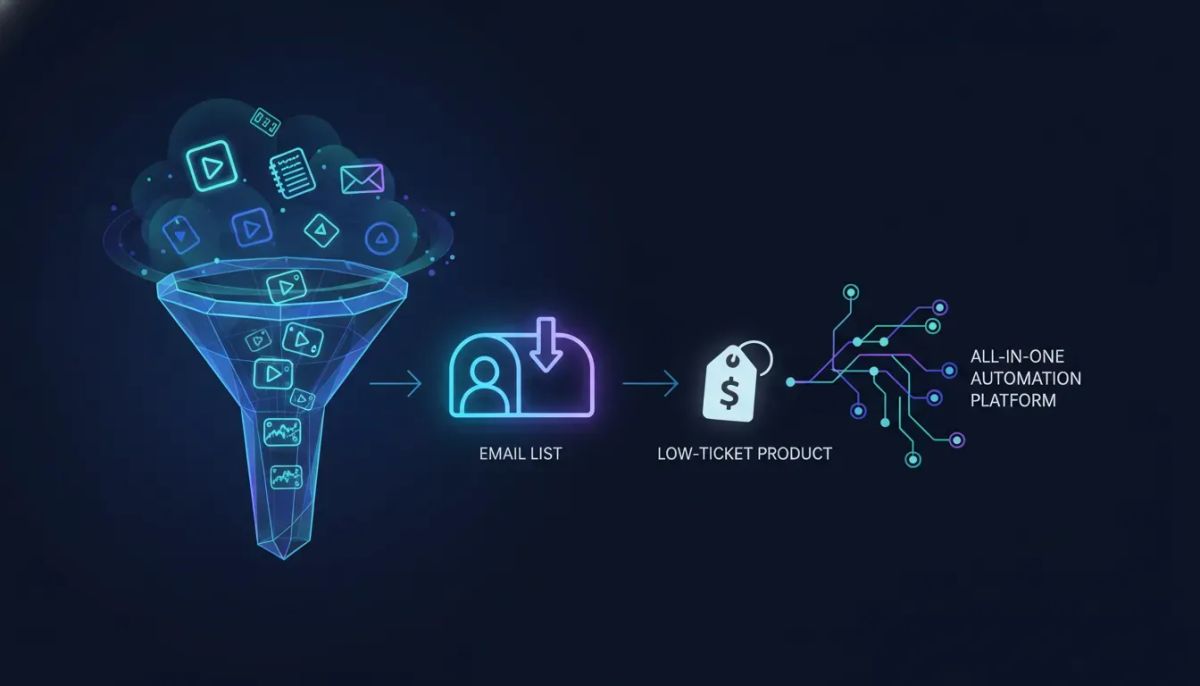
The whole idea is simple: build attention with short-form content, move that attention off rented platforms and into an owned email list, then offer a low-ticket digital product that actually matches what your audience wants. And if you are using HighLevel, you can build the capture, automation, delivery, and follow-up system in one place instead of duct-taping ten tools together.
This approach did not come from theory. It came from necessity. After losing a Facebook account that had been generating serious monthly profit, the lesson became painfully clear: if you do not own the audience, you do not own the business.
The core lesson: content matters more, not less, in the AI era
A lot of people hear “content” and immediately recoil.
They think it is only for influencers, extroverts, or people who love hearing themselves talk. That mindset is dead weight now. In the age of AI, it has never been easier to build products, write copy, generate designs, create lead magnets, or spin up automations. Which means the bottleneck is not creation anymore. The bottleneck is attention.
If everyone can build faster, then distribution becomes the advantage.
That is why short-form content is such a powerful play. It is one of the most asymmetric bets available in business right now. The downside is mostly your time and willingness to be uncomfortable for a while. The upside is that one post can change your audience size, your lead flow, and your revenue trajectory.
Think of every short-form post like a free lottery ticket. You are posting into platforms with billions of users, powerful recommendation algorithms, and constant demand for content. One good piece can travel far beyond your follower count.
That does not mean every post wins. It means the game is worth playing.
Why you should stop depending on platforms you do not own
The reason this system matters is not just growth. It is protection.
If your audience only exists on Facebook, Instagram, TikTok, or YouTube, then your business is sitting on rented land. Algorithms change. Accounts get restricted. Monetization terms shift. A platform can decide overnight that your reach is worth less than it was yesterday.
That is why the real objective is not just getting likes or followers. It is getting people off the platform and onto an email list, a CRM, and an automation system you control.
With HighLevel, that means using a landing page, funnel, form, workflow, and email sequence to capture and nurture the lead. The social platform gets you discovered. Your HighLevel system turns discovery into an asset.
The simplest version of the $97 offer
When people hear “digital product,” they often imagine they need a course platform, a community, polished branding, and a giant content library.
Usually, they do not.
A digital product can be as simple as:
- A PDF guide
- A Google Drive folder
- A set of templates
- A swipe file
- A recorded training
- A playbook built from your own process
One of the clearest examples was a $97 product that was literally a Google Drive link containing highly tactical consulting recordings. No fancy membership portal. No moderators. No complicated infrastructure. Just valuable information packaged clearly and sold to an existing email list.
That simple offer generated $120,000 in profit in roughly 30 to 45 days.
The point is not that everyone will get the same result. The point is that a product does not have to be complicated to be valuable.
If the information solves a real problem, people will pay for access.
The Complete Operating System for Growth
Join over 60,000+ agencies and businesses using HighLevel to capture more leads and close more deals. Start your trial today and get instant access to the Nexus Hub resources.
Claim Your Free Trial & BonusesYou do not need a massive following
This might be the most important mindset shift in the whole system.
You do not need a million followers.
In many cases, a thousand loyal fans are far more valuable than a giant disconnected audience. If people know what you do, trust your perspective, and associate you with a specific problem you can solve, that audience is monetizable.
There is an old idea called 1,000 True Fans. The math is simple:
- 1,000 true fans spending $100 per year = $100,000
- 100 true fans spending $1,000 per year = $100,000
That is not just theory. Niche operators are building real businesses with tiny but highly relevant audiences. Someone with 2,000 followers discussing a specific service can outperform a much larger creator if the audience is more qualified.
Follower count is a vanity metric unless the audience and offer match.
Short-form content is a retention game
Every platform wants the same thing: more attention.
They want people to stop scrolling, keep watching, and stay on the platform longer. If your content helps them do that, they reward you with more distribution.
That is the whole retention gospel.
The algorithm is essentially asking two questions:
- Did this piece stop the scroll?
- Did this piece keep the person watching?
If the answer is yes, the platform pushes it wider. First to your immediate audience, then to a larger pool of similar people, then broader still. It keeps expanding until the engagement weakens.
That means your job is not just “make content.” Your job is to structure content in a way that earns retention.
The hook matters more than most people realize
A strong hook is what prevents the swipe away.
One accidental breakthrough hook was:
Look at this friggin’ thing right here.
That phrase consistently lowered swipe-away rates because it created immediate curiosity. The lesson is not that everyone should copy that exact wording. The lesson is that small changes in the first second can massively affect performance.
Your opening should make the right person think, “Wait, what is this?”
The “hide the idea” framework
One of the smartest ways to improve retention is to delay the payoff without becoming clickbait.
The structure looks like this:
- Hook the right audience
- Promise a payoff
- Build curiosity
- Deliver the answer at the end
Example: if your topic is lawn care, do not open with the exact product recommendation. Open with something like, “I cannot believe how green my grass got from this one simple trick.”
Now the audience knows there is a specific result coming. They stay for the explanation. You walk through the problem, the trial and error, the process, and then reveal the solution at the end.
That is “hide the idea.”
You are not withholding value. You are structuring it so people stay long enough to receive it.
How to choose your niche without overthinking it
At the beginning, test broadly.
Test topics. Test formats. Test angles. Test delivery styles.
If you are brand new, you are not looking for a perfect niche on day one. You are looking for signals.
The two signals that matter are:
- The algorithm likes it
- You actually enjoy making it
If a topic gets traction but drains your soul, it is probably not sustainable. If you love a topic but the market ignores it, keep testing related angles until you find overlap.
A useful lens here is the Japanese Ikigai concept. Look for the overlap between:
- What you love
- What you are good at
- What people will pay for
That overlap is usually where a durable content-and-offer strategy lives.
And no, your niche is not too small. Even an extremely narrow audience can be wildly profitable if the people are qualified and loyal.
Stay in your lane once you find traction
Early on, test everything.
Once you find a lane that works, stay in it.
If people begin to associate you with lawn care, business ideas, bookkeeping systems, agency operations, or orthodontic marketing, then that identity becomes valuable. It helps the platform understand who to show your content to, and it helps your audience understand why they should care.
This is why follower count is not completely meaningless. Followers are data points. They train the platform on who your content is for.
If you suddenly switch from one niche to something unrelated, you muddy the signal.
That does not mean you can never explore. It means if you want to test something new, a separate account is often the cleaner move.
Use separate accounts for posting, research, and fun
This is a sneaky practical tip that matters more than it sounds.
If you want to study your niche, create a separate social account for research. Do not follow people you know. Do not clutter it with random interests. Train the algorithm to show you examples only from the type of content you want to make.
That gives you cleaner inspiration.
Then keep another account for your actual posting, and if needed, another for personal scrolling. Otherwise your feed becomes chaos and your research gets polluted by unrelated content.
How to move people from social media to your email list
This is where HighLevel becomes the operating system.
The goal is not to send people to a messy page full of choices. It is to reduce friction.
That is why the advice was to avoid something like a bloated link hub with too many options. If you give people ten places to click, many will click nowhere.
A better flow is:
- Short-form content creates curiosity
- A strong CTA offers a useful free resource
- The CTA sends people to a simple HighLevel landing page
- The landing page collects an email address
- A HighLevel workflow sends the promised asset
- A welcome sequence nurtures the lead
- Later, a $97 offer is presented
That free resource could be:
- A business plan
- A PDF playbook
- A checklist
- A template pack
- A niche-specific guide
It does not need to be complicated. In many cases, AI can help generate the first draft of that lead magnet quickly, and then you refine it with your expertise.
Why the CTA matters so much
There are weak calls to action and strong calls to action.
A weak CTA says, “Follow me for more.”
A stronger CTA is embedded in a reason to keep watching and a reason to act. For example:
“Here’s why this is a brilliant idea, where to find it, and how much you can charge.”
That single line creates multiple curiosity loops. It tells people the video will answer specific questions, and then the CTA rides on top of that momentum.
For lead capture, one of the best CTA structures is a trigger word tied to a workflow. A piece of content promises a useful asset, and people comment a keyword like “plan.” Then HighLevel can trigger the follow-up, collect the lead, and send the promised resource through automation.
That is where content meets CRM.
The messy middle problem in email marketing
Here is one of the most useful email insights from the workshop:
There are two times people are most likely to care about you.
- The day they subscribe
- Much later, if they have become deeply loyal
Everything in between is the messy middle.
Most people market hardest in that messy middle, when the lead is no longer hot and not yet truly loyal. That is why welcome sequences matter so much. When someone first opts in, that is your best chance to deepen the relationship.
In HighLevel, this means your first workflow matters more than almost anything else. A clean welcome sequence, timely delivery, and relevant follow-up can dramatically improve conversion compared to dumping leads into a generic newsletter.
Platform-specific notes that are actually useful
At a first-principles level, every platform wants retention. But each one has its own personality.
TikTok
TikTok is highly sensitive to watch time and average view duration. People are more finicky there, so keeping them to the end matters a lot. It is a great place for testing content fast, but generally lower-value when it comes to lead quality and monetization.
Instagram rewards shareability, especially through DMs. Good watch time plus strong sharing behavior is a powerful combination. Lead quality tends to be better than TikTok.
Facebook is massively underrated. The audience is older, often more commercially valuable, and more likely to open emails and buy. For lead generation and digital product sales, it can outperform trendier platforms.
YouTube Shorts
YouTube seems to care heavily about swipe-away rate. If people do not skip your short, it can keep pushing the content broader. Long-form YouTube also creates unusually strong trust because people spend much more time with you.
LinkedIn tends to reward early engagement, especially replies. For B2B operators, agencies, consultants, and niche service providers, a small engaged LinkedIn audience can be extremely valuable.
Twitter/X
Twitter values sharing, especially when content gets copied and passed to people off-platform. It is smaller than many assume, but a tight niche audience there can still be very profitable.
How this applies to agencies, consultants, and niche operators
If you run an agency, offer local services, sell SaaS, or work in a niche like plumbing, accounting, real estate, orthodontics, or home services, this system still works.
In fact, it may work even better because your audience can be more qualified.
You have two broad options:
- Go niche-first and create content specifically for a defined audience
- Go personality-first and build around your own brand, story, and interests
The niche-first route usually gives you a smaller but more valuable audience. The personality-first route often creates a broader audience, but each lead may be less qualified.
Neither is wrong. The key is understanding the tradeoff.
If your HighLevel agency setup depends on acquiring specific local business clients, niche content may produce stronger product-audience fit. If your business model is more brand-led, a personal approach can work well too.
Product-audience fit is everything
You cannot just build an audience and assume they will buy anything remotely related.
The real win is product-audience fit.
The easiest way to find that fit is to ask. Use stories, polls, DMs, and comments to find out what your audience actually struggles with. Then build the offer around those answers.
That is how you avoid creating a product nobody wants.
Audience research is not glamorous, but it is often the difference between a weak launch and a strong one.
What about faceless content?
Yes, faceless content is possible. AI avatars and generated videos are getting better fast.
But there is a tradeoff.
As AI content becomes more common, authentic human presence becomes more valuable. Real stories from real people stand out more now, not less. If you can bring yourself to be on camera, even imperfectly, that is likely the stronger long-term play.
Faceless can work. Human tends to connect better.
Keep the system simple
One of the recurring themes here is simplicity.
- A simple offer
- A simple landing page
- A simple email capture
- A simple automation
- A simple welcome sequence
You do not need a giant course portal, an overbuilt website, or a dozen branching workflows to start. You need a useful resource, a clean promise, and a reliable way to collect and follow up with leads inside your CRM.
That is exactly where HighLevel shines for agencies and operators who want one place to manage funnels, workflows, email, CRM records, lead capture, and automations.
FAQ
Do I need a huge audience to sell a $97 digital product?
No. A small, loyal, well-matched audience is often more valuable than a large, unfocused one. Product-audience fit matters much more than raw follower count.
What counts as a digital product in this system?
A digital product can be a PDF, recorded training, template pack, swipe file, playbook, or even a Google Drive folder containing useful resources. It does not have to be complex to sell.
Why is email capture so important?
Because social platforms are rented land. Email gives you a direct line to your audience that you control. With HighLevel workflows and automations, you can also nurture and convert those leads more effectively.
Should I use one account for everything I post?
Not necessarily. It can help to separate your posting account from your research account and personal scrolling account so your content inspiration stays focused.
Can this work for agencies and consultants?
Yes. This is especially relevant for agencies, consultants, and niche operators using HighLevel for CRM, lead capture, marketing automation, and SaaS operations. A focused niche audience can be extremely profitable.
What is the best platform for leads?
It depends on the niche, but Facebook was highlighted as especially underrated because the audience tends to be older, more email-responsive, and more likely to buy. Instagram also performs well. TikTok is useful for testing but often lower in lead value.
Do I need to show my face on camera?
No, but it is usually the stronger long-term move. Faceless content can work, especially with AI tools, but real human connection tends to outperform generic AI-style content over time.
What should my HighLevel setup include for this launch system?
At minimum: a simple landing page, an email capture form, a delivery workflow, a welcome sequence, and a follow-up path to your $97 offer. That gives you a complete baseline system for lead generation and conversion.
Final thought
If you have expertise, you are already sitting on raw material for a digital product.
The missing piece is usually not more knowledge. It is a system.
Create content that earns attention. Structure it around retention. Use strong CTAs. Move people onto a list you own. Deliver value fast. Then offer something simple and useful.
That is the engine.
And with HighLevel, you can turn that engine into an actual operating system for growth instead of a stack of disconnected tools and good intentions.